The Dordogne is synonymous with Southwestern gastronomy, with its wines, foies gras, confits and, of course, truffles. Here’s our itinerary for a successful stay in the Périgord.
The cradle of humanity, the Dordogne is a culturally rich region with sites dating back to prehistoric times, where the first traces of “homo sapiens” man can be found, and numerous castles dating back to the Middle Ages.
By way of background, the Dordogne is one of the most visited departments in the Nouvelle Aquitaine region of France. With three million visitors in 2016, I can understand why there are so many tourists: listed prehistoric sites that trace the lives of our ancestors, 400,000 years of history scattered throughout the region, such as Lascaux, cities of art and history, including Sarlat, the most famous medieval town, Périgueux, the capital of Périgord, and Bergerac with its wines. The Dordogne is also home to 10 villages classified as “plus beaux villages de France” (France’s most beautiful villages), as well as natural areas ideal for canoeing, one of the best ways to discover the Périgord, and a rich and tasty gastronomy with exceptional local produce.
When we speak of the Dordogne, we often think of the southwest, but also of the Périgord. But did you know that there are four Périgord regions?
- Green Périgord, to the north, where meadows and forests of light oak and chestnut grow.
- Périgord blanc, named after the limestone soil in the central and north-western regions around Périgueux and Ribérac.
- The Périgord Noir around Sarlat, characterized by dark-leaved holm oak forests
- Purple Périgord around Bergerac, named for its many vineyards
Leaving Paris on Thursday evening, we travel by train to Bordeaux and Périgueux (journey time: 3h30). This practical and varied itinerary provides a good overview of grand sites du Périgord over 3 full days. I’d like to share with you our best restaurants, our gourmet addresses and our favorites of the Périgord Noir.

J1 | PÉRIGUEUX, BOURDEILLES AND CADOUIN
If you arrive in Périgueux on a Thursday evening, remember to sleep at Mercure hotel ideally located, midway between the amphitheatre and the Mataguerre Tower. Built in the town’s former police station and decorated on the theme of Lascaux, this is a pleasant, modern hotel with a hearty breakfast. You’ll find what you’re looking for in terms of accommodation by clicking here.
À Périgueux, we recommend that you dine at the wine court, place Bugeaud. Don’t expect a conventional restaurant, but rather a tapas bar and wine shop. We tasted very good local wines (Bergerac, Montbazillac, Peycharmant) accompanied by charcuterie, cheeses and a superb seasonal dessert with raspberry and mango, a real treat.

- Périgueux
The city is not very large, and you can choose to visit it on your own or hire a guide from the tourist office. It comprises a Roman section dating from the 1st century BC and a medieval section built in 1240.
We suggest you stroll from street to street, from square to square, taking the time to stop off at Place du Coderc or have lunch on a terrace in Place Saint Louis. For the cultural side, you’ll need to visit the “Mataguerre” tower at the foot of Place Francheville. This tower marks the boundary between the medieval town and the ancient Roman city. It can be visited in July and August for €2/person. Nearby, you can also visit the amphitheatre at the end of Rue des Gladiateurs. Continue your stroll along Rue Taillefer to Cathédrale St Front. Built in the shape of a cross, its size is impressive. It can accommodate 1,500 people. Beautiful stained glass windows adorn the building, and an adjacent cloister can be visited in the afternoon for €1/person. You’ll need half a day to visit the city. Tip: climb the tower’s terrace to admire the superb panorama.
You can sit on the terrace and enjoy a cup of coffee at the veloc café and have a drink and lunch on the barge from Périgueux (rue Nouvelle des Quais)


- Bourdeilles castle
Now let’s hit the road in the direction of Bourdeilles, 20 min from Périgueux to discover its castle. It comprises a 13th-century medieval section with its keep, a Renaissance section with its gardens and a château featuring a collection of beautiful 16th-century furniture. Family activities are organized during the Easter and summer school vacations, including coat-of-arms making, medieval calligraphy and other puzzles. On Thursday evenings from mid-July to mid-August, a treasure hunt is organized at 8pm, taking in the site’s various points of interest. This team game is a fun way to explore the site, and will appeal to young and old alike.
Where to have lunch in Bourdeilles? We recommend a stop at thesensory workshop, on the main street. This semi-gastronomic restaurant offers cuisine based on local produce. A good address just a stone’s throw from the castle entrance on the square below.


- The Cadouin cloister
Let’s continue with a visit to the Gothic cloister of Cadouin, a Unesco World Heritage site about 40km south of Périgueux. All the buildings of this Cistercian abbey dating from 1115 are still visible: the church, of course, the accommodation, now converted into a youth hostel, and of course the cloister. The latter is remarkable for its decorations and architecture. An atmosphere of serenity is sure to envelop you as you enter, and you can explore the site with the help of an audio guide to get to the heart of the story. If you have a little time to spare, take the opportunity to stroll through the streets of this small village. I really enjoyed the aperitif in the heart of the cloister, with an on-the-spot tasting of a number of local wines accompanied by delicious truffled foie gras toasts, organized by l’Association Foie gras du Périgord. Continue on to Monpazier.


J2 |MONPAZIER, BIRON and EYZIES DE TAYAC
- Monpazier
On this second day, we start with a stroll through the center of Monpazier. The Halle du Marché square is particularly beautiful, with its unique wooden arches and beams. Don’t miss an early-morning drink or coffee on the quiet, sunny terrace.
Where to stay in Montpazier? enjoy the Hotel Edward 1er in a former manor house converted into a hotel. The decor is inevitably charming and the spirit quite old-fashioned. The establishment is located in a quiet, pretty village and has a swimming pool with a lovely view. The hotel’s semi-gastronomic restaurant is a very good address where the chef works with local produce. A place we highly recommend!


- Biron
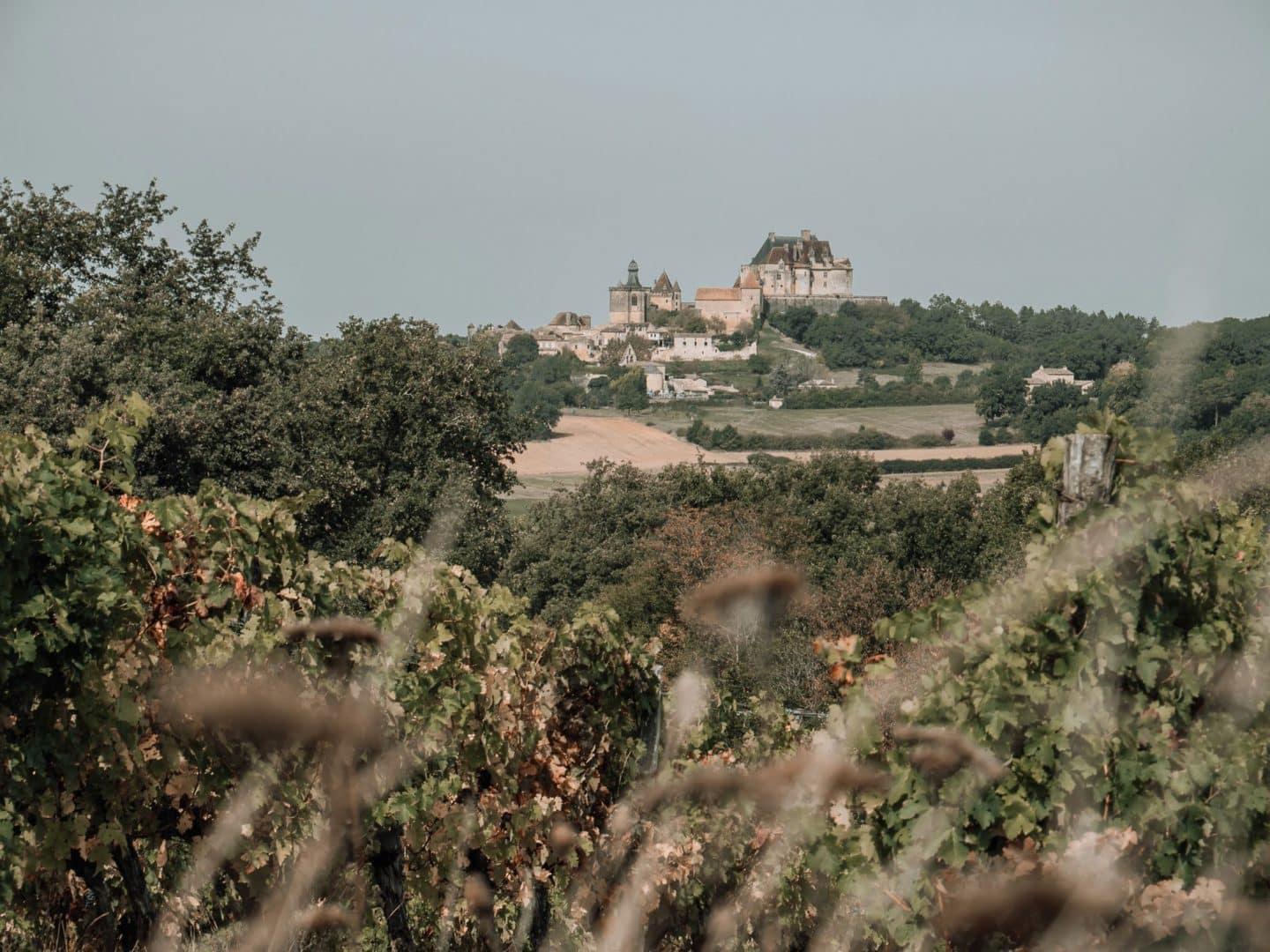
Not far from there, you can also visit the Biron Castle and its superb panorama, awarded the”Major Aquitaine site“. Dating back to the 12th century and subsequently undergoing various changes, it remained in the hands of the Gontaut-Biron family until 1938. The castle’s unique architecture demonstrates the family’s power and influence with the kings of France. To discover it in the way we like it, note that gourmet markets featuring local producers take place in the château courtyard every Thursday in July and August. You can eat there after the tour, as the château closes at 7.30pm. Visioguide tours and enigma books for children are available, as are discovery workshops (booking required).
| Admission: Adults €8.30, children aged 5 to 12 €5.40. Combined Biron/Cadouin ticket: Adults 11.90€ and children aged 5 to 12 7.10€.


- Eyzies de Tayac
After the castles, it’s time to discover the geological and prehistoric sites of Périgord. Located on the commune of Les Eyzies de Tayac, you can discover the prehistoric shelters of Laugerie Basse and the grotte du grand Roc. This cave is a superb creation of nature and can be visited in 3/4h. You’ll discover extraordinary calcite sculptures, crystallizations, stalagmites and stalactites. Just a stone’s throw away, and without taking your car back, come and discover the prehistoric shelters of the Laugeries basse. The prehistoric shelters at Laugerie-Basse have been inhabited by our ancestors for several periods, including Cro-Magnon 15,000 years ago. On this UNESCO World Heritage site, numerous traces of prehistoric man have been found, showing how he tamed this environment to make it his habitat. A unique place for history buffs. The tour begins with a 3D film, followed by a fun trail. It’s enlivened by reproductions of prehistoric scenes, but also by the use of a digital tablet for a playful approach, with augmented reality options showing you the places you’re in as Cro-magnon men must have seen them.
The village of Les Eyziers has been dubbed the world capital of prehistory, and we highly recommend a stop-off just to stroll through the narrow streets and admire the unique troglodyte architecture. We found it incredibly charming, with its houses set into impressive cliffs overlooking the Vézère river.
➡️ If you have a little time to spare, you can discover the villages of Beynac and Domme, ranked among the Most Beautiful Villages in France. I found an original outing that combines a walking tour with a cruise on the Dordogne to see the medieval castles along the river. Check availability and book here.


J3 | LASCAUX CAVES AND THOT PARK
- The Lascaux caves
Last day of our weekend in Périgord. Make way for the region’s long-awaited iconic site, the Centre International de l’Art Pariétal better known as Lascaux.
I’ve always loved the prehistoric period, and now I understand why this place has fascinated travellers from all over the world since it was discovered in 1940 by 4 local teenagers. This cave is one of the rare testimonies of men having lived here 17,000 years ago, preserved no doubt thanks to the specific geology of the site. The cave was closed in 1960 to protect it from bacterial growth, and is currently in good health. From the very first paintings, chills run down my spine… you enter this dark tunnel and discover these incredible paintings!
In 1980, Lascaux II was created, a reproduction of the 1st room as you enter the cave, in order to pass on this heritage to as many people as possible. This site is still available for thematic visits but is now replaced by LASCAUX IV.
This new showcase was opened in 2017 in an architectural style that blends in with the local geology. The entire cave has been reproduced to 1/2 millimetre accuracy in 2 rooms, which you can visit with a guide. You’ll then be taken to a workshop room, where you can use your digital tablet to find out more about the paintings and techniques used by the men of the time. The tour continues with a visit to the Cave Art Theatre, the 3D cinema and temporary exhibitions by artists inspired by the world of Lascaux. For more fun, you can also take a tour with augmented reality goggles and wander around the cave at your leisure. You can also create your own exhibition on a digital board in the Imagination Gallery. A real plus, bringing a modernity to the exploration of a period that is difficult to portray.
| Admission: €16/person/ Time required: 4h for a leisurely tour.


- Le Parc de Thot
You can then go to the Thot Park just a few minutes from Lascaux to discover prehistoric animals. You’ll see the animals that inhabited these lands 17,000 years ago: bison, deer, ibex, fallow deer, etc. An ideal park for families, where you can take part in creative workshops on cave art, oil lamp making and flint knapping. These introductory workshops must be booked in advance. Having seen wolves in Mercantour National Park, We only regret that the space reserved for the wolves seems too small for these animals, bringing us back to our own era with its questions about respect for animal welfare.
Equipped with paintbrushes and natural pigments, we took a moment to learn about cave art and tried our hand at reproducing cave paintings on a corner of the wall. A workshop that lets your imagination run wild!


The Dordogne is a region worth coming back to several times. With so much to see and do, there’s plenty to see and do: villages, castles, gardens, caves, rivers, forests and panoramic sites. All these places deserve to be discovered from near and far, but believe me, you won’t be disappointed!
Don’t forget to pin the article on Pinterest to find it more easily.

This article is our experience. It was made possible thanks to a collaboration with Semitour who we would like to thank for their invitation and this superb discovery of the region.