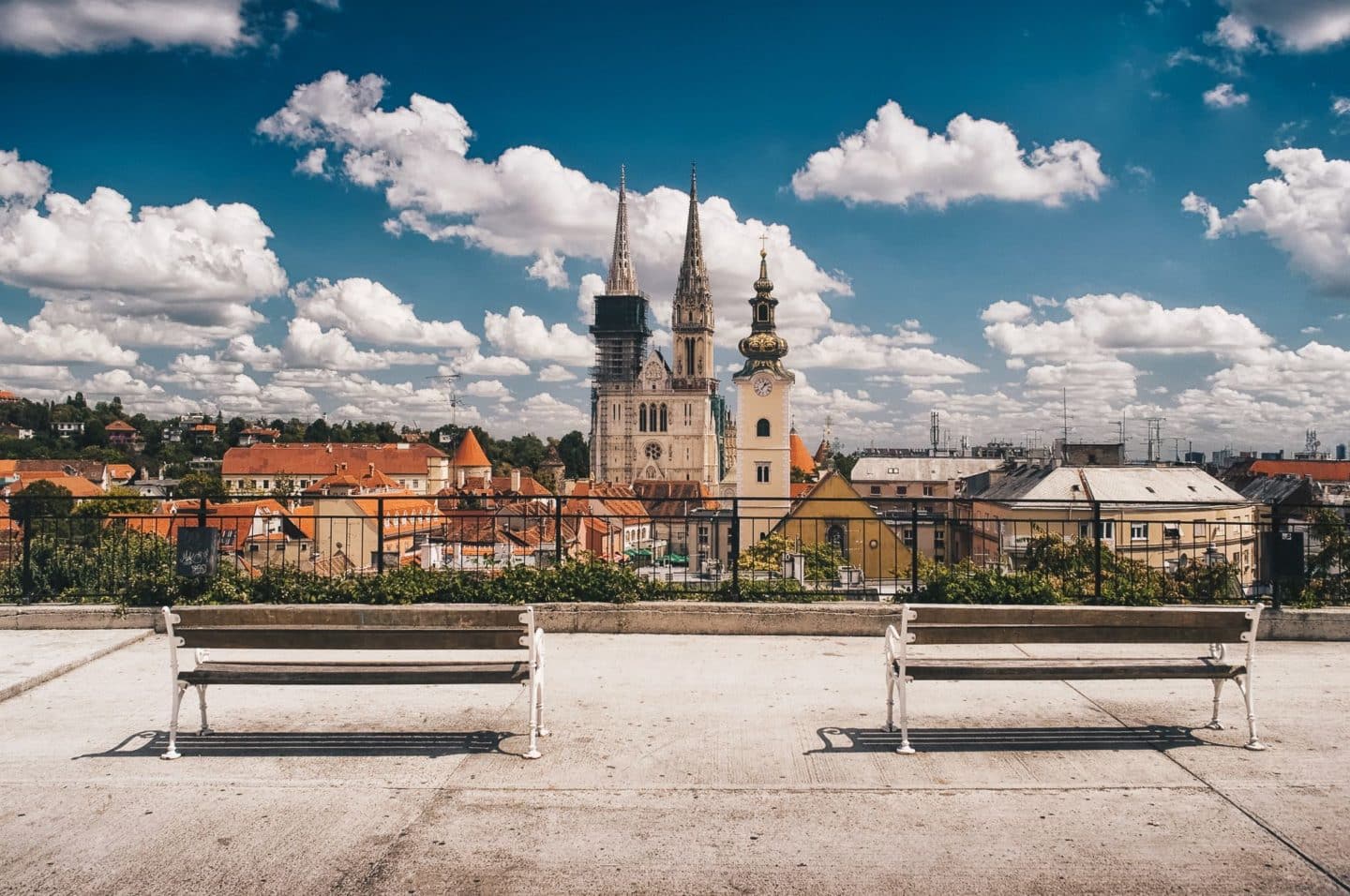
Zagreb will surely be the first stop on your trip to Croatia. But what is there to do in Zagreb? Discover this very pretty capital, its beautiful architecture and its varied activities.
What a lovely surprise! We didn’t really know what to expect when we arrived in Zagreb and we thought we’d find a city in the former Yugoslavia with little in the way of architecture, as the great Communist dictatorships of the second half of the 20th century knew how to do. And to say that we didn’t see any of that on the outskirts of the city would be lying to you. But what we did find in Zagreb were traces of the Austro-Hungarian past in the historic centre of a city on a human scale. In this guide, you’ll find information on the main sites to see in the city, as well as our picks for accommodation, restaurants and bars, and at the end, practical information to help you organise your trip. (transport, flights, car hire).
Zagreb is the first stop on our 7-day trip to the Gulf of Kvarner, a place we recommend as the region is little known to travellers.
Discover all our articles about this superb region:
- I7-day tour of the Gulf of Kvarner
- The Plitvice Lakes National Park
- Krk, the surprising island perfect for a break


TABLE OF CONTENTS :
| THE HIGH CITY OF ZAGREB
- The old town and its funicular railway
Zagreb’s Old Town, also known as the Upper Town, is situated on two hills, Kaptol and Gradec, formerly two towns separated by a river. Most of the monuments were therefore built on this side and are higher up. Don’t worry, all you have to do to get there is climb a few minutes of stairs or take the world’s shortest funicular. In just one minute, clock in hand, you’ll cross the sixty metres separating the modern city from the protected medieval quarters. It runs from 6am to 9pm.
This shortest funicular railway in the world (around 66 metres long) on rue Tomiceva, used to transport locals between the upper and lower parts of the city. Today with its vintage blue look, it’s great fun to photograph as you no longer need to take it to get to Gradec Hill. (Count about 4 HRK per journey). At the top of the funicular, you’ll arrive at the belvedere right next to it. From here, you can admire the rooftops and monuments of the lower town. To get there, go through the courtyard of the Hotel Jagerhorn, a friendly establishment located on Rue Llica, one of Zagreb’s liveliest thoroughfares, and then climb the stairs. A small path topped by a low stone wall will then lead you to “the observatory“.
There is also a telepheric cable car named Zicara, which connects Zagreb to the Medvednica mountain in 20 minutes if you’re looking for height.


- Mirogoj Cemetery
Located at the foot of Mount Medvednica, in the Medveščak district, Mirogoj Cemetery is a stunning and pleasant place to take a stroll. It is considered to be one of the most remarkable monuments in the city of Zagreb. Under the arcades are the graves of many famous Croatians, and all religious groups are welcome whether you are Catholic, Orthodox, Muslim, Jewish or Protestant. A map at the entrance indicates the location of the tombs of several important figures. It is about a 30-minute walk from the city centre. If you don’t want to walk, you can get there by bus. The cemetery is open every day and admission is free.

- Strossmartre
The Strossmartre promenade is actually the pedestrian alley that runs along the edge of Gradec hill (at the top of the funicular). It is theone of the quietest and most pleasant alleys in Zagreb. You can find garland of lanterns and stalls selling things to nibble on or drink. The view over the city from up there is really nice, as are the terraces. There’s a very cool bobo feel with a guinguette spirit. We love it!

- St Stephen’s Cathedral Zagreb
St Stephen’s Cathedral in Zagreb is today the highest monument in Croatia. Romanesque in style, it is located in the upper town in the heart of the Kaptol district just opposite the obelisk. In 1880, it was badly damaged by an earthquake. It has since been restored to its current form. Incidentally, the old clock outside the church still reads 7h03, the time when the magnitude 6.9 earthquake shook Zagreb. Admission is free.

- La tour Lotrsčak
You won’t want to miss it, as it’s right at the end of the funicular. From the top of this tower, the panorama of the city is quite beautiful, especially under a blue sky. For over 100 years, a cannon has been fired from here every day at noon to tell the locals what time it is, so take the opportunity to climb the tower, admire the view, take photos of the city’s main monuments and listen to the sound of the cannon. (Admission charge, around 20 HRK/p)

- The Museum of Broken Hearts ” Broken relantionships “
This highly original museum is located just behind the Lotrsčak tower. We discovered the atypical “broken hearts” museum, where objects are exhibited along with their sometimes funny, sometimes tragic stories. Most of these stories are about lost love, with more or less happy endings. There’s bound to be one that speaks to you! The idea of this museum is really brilliant, and we recommend it! Once again, we advise you to come either when it opens or in the evening, as it can get very crowded. We did it in the morning and then had a coffee break on the museum terrace.
Opening hours 9am to 10.30pm , entrance 40 HRK/p ; 2, rue Ćirilometodska

- L’Eglise Sainte Catherine
The segway blew us past, but this baroque church doesn’t look like much from the outside. Apparently the interior is quite beautiful and contrasts with the simple façade. It’s right next to the Museum of Broken Hearts. Admission is free.
- St Mark’s Church;/strong>
The church of St Mark is perhaps the monument I liked best, along with the pretty cobbled square and the Croatian government buildings around it. The place is really worth a visit, but it’s also very famous. The church is easily recognisable, with its colourful tiled roof, which perfectly illustrates the emblems of the city of Zagreb and of Croatia. I advise you to go there very early in the morning to take some lovely photos. We were there in May during the bridge and the square was the setting for role-playing games with characters from yesteryear, recalling the era.


- Le Tunnel Gric
We didn’t have time to visit it, but our guide told us about it. This tunnel is located under the Gradec hill and was built during the 2nd World War as a refuge in case of attack. Since 2016, it has been open to the public and regularly hosts cultural events. It’s not a must-see, but it’s also a shortcut between Mesnička and Stjepan Radić streets to save yourself the climb up the hill. If you are passionate about history, I invite you to discover this guided tour around the fall of communist Yugoslavia and the quest for independence in the disastrous Croatian War.
Click here to book your guide
| THE LOWER CITY OF ZAGREB
The lower part of Zagreb, built in the 19th century, is the newest and liveliest section of the city. If you take a good walk around Zagreb, you may come across some graffiti.
- Zrinjevac Park and Botanical Garden
Zabreb has some very pretty parks with kiosks to relax in, so it would be a shame to miss out. You’re bound to pass through the city’s green lung by segway or electric bike, and we recommend that you take the walk from one end to the other. Zrinjevac Park is located very close to the main square and continues as far as the railway station. When the weather is fine, there are temporary bars and festivals nearby, making it a lively place for young Zagrebians. To the right of the station, continue towards the botanical garden where you will find turtles and carnivorous plants.


- The Croatian National Theatre
At the end of your stroll through Zrinjevac Park, you’ll come across the Croatian National Theatre, a beautiful yellow building founded in 1840.

- Le marché Dolac
Big because Antoine and I love markets when we travel. It’s the best way to meet the locals, listen to them talk and exchange ideas…. Don’t miss strolling the aisles of the Dolac market located just above the Ban Jelačić square, the hub of tram traffic. A very authentic market which takes place every morning and which sets the mood for trying out a Croatian tradition, that of going to drink a macchiato or an espresso on the terrace of one of the city’s many cafés where the locals have their habits. One of the best places for this is certainly the square ” Petar Preradivic ” where you will find a small flower market. What a delight! For the more curious, just a few metres from the colourful stalls and the smell of spices, look out for the work of sculptor Stjepan Gračan or ask where the statue Kumica Barica.


- La place Ban Jelacic
You’re bound to come across the very pretty Place Ban Jelacic. This is where the locals get together for a festive event. The facades lining the square reflect the local architecture and the view from the roof of l’hôtel Dubrovnik will give you a great overview. I really enjoyed sitting in the hotel’s armchairs just watching people getting on and off the tram and soaking up the atmosphere. It was the day after we arrived in Zagreb.


<&lgt;p>&lgt;strong> &lgt;/strong>&lgt;
- Discover Zagreb differently
There are several ways to visit the city, starting broadly to soak up the atmosphere and spot places you’ll be coming back to later. And it’s on a Segway that we’ve chosen to explore Zagreb. The segway is an electric device that runs on 2 wheels with high handlebars. This was a first for us, and an efficient and fun way of getting around the city to get a good overview before returning on foot to explore the areas that interest you most. The team will help you get to grips with your segway while explaining the history of Zagreb and the people who have left their mark on the Croatian capital. We were able to discover charming cobbled streets, a city with characterful buildings in an architectural style similar to some of our Parisian monuments, with the typical yellow colour of Austro-Hungarian buildings. Expect to spend a full day exploring the city, including a 2-hour ride on the Zegway, which is really worthwhile;
➡️ Book your segway outing online
On this 2-hour cultural walk, you will discover the main attractions:
✖️ the National Theatre dating from the 19th century
✖️ the Umjetnički Pavilion built for the 1896 Universal Exhibition around the “Lenuzzi Horseshoe”
✖️ the Zrinjevac Park with its musical kiosk
✖️ the Cathedral
✖️ St Mark’s Church
✖️ The Lotrsčak Tower

You’ll find all types of hotel and, as everywhere in Croatia, rooms in private homes or flats, as Croatians didn’t wait for Airbnb to supplement their income in a country where the average salary is still €650. Find what you’re looking for here for accommodation.
- hotel Dubrovnik, a central hotel, very well located, opposite Ban Jelačić square. The view is super pretty!

- l‘hotel Président Zagreb and but no longer available on May bank holidays.
Swanky Mint Hotel
- , quite close to the central square.
- If you prefer to book a flat, I suggest you take advantage of €34 off your Airbnb booking
| OUR RESTAURANTS, BARS AND CAFES, COUP DE A ZAGREB
If, like us, you enjoy discovering local dishes during a trip, we invite you to try this experience which will allow you to get to know the Croatian dishes most representative of various regions while visiting Zagreb and above all to meet the locals.
➡️ Book now for the cookout to try a local experience.
The streets Opatovina, Tkalčićev with its colourful facades and Teslina are the centre of local life where you will find bars, shops and restaurants.
- We tested the restaurant Agava (Ul. Ivana Tkalčića 39). Renowned and frequented by locals and tourists alike, you’ll find Croatian cuisine with a strong Italian influence, including risottos, pasta and one or two purely Croatian specialities. It’s good, but a bit expensive for the quantity! The Agava restaurant cost us €70 for two for 2 starters + 2 main courses (500 HRK)
- restaurant Kaptolska Klet for a taste of many specialities (Kaptol ul. 5, 10000)
- Le restauran Lari & Penati, a very pleasant restaurant with a terrace serving soups, salads and fish (42a, rue Petrinjska)
- At the restaurant la Struck you can try štrukli, a typical Zagreb gratin dish made with pasta and a mixture of cheese, egg and sour cream, a kind of lasagne. There are savoury and sweet versions. Special mention should be made of the truffle štrukli (Skalinska ul. 5, 10000)
- The restaurant Vinodol is fairly well known in Zagreb, but we didn’t have the time to try it. (Ul. Nikole Tesle 10, 10000)
- Le Heritage Street food is an original concept because you can try lots of Croatian street food dishes. They use local producers for their produce, which is also on sale in the restaurant. Don’t forget to book in advance, as it can get very busy! (Petrinjska ul. 14)


- La rue Tkalciceva is as famous as rue de la soif in Rennes. Here you’ll find trendy bars and restaurants.
- The pub of the brewery Medvedgrad Llica which offers very good beers and Croatian dishes. (Ilica 49, 10000)
Petra Preradovica
- is a café-lover’s paradise. Take the opportunity to admire the facades and architecture of the buildings.
- Average price of a restaurant: From 100 to 250 HRK / pers
- Price of a coffee: Expresso: 10 HRK; Macchiato: 12 HRK; Market fruit 7HRK for 1 banana and 500 grams of strawberries.
Practical information Zagreb
| GETTING TO ZAGREB AND LOCAL TRANSPORT
- Arriving by plane: We used the flight comparison service Skyscanner. It’s the only one I use for my bookings and that’s how we found a flight from Paris to Zagreb at 225€/p with Air france. To check availability and book your flight at the best price, click here.
- From the airport, Zagreb city centre is around 20 minutes away. Remember to hire a car to get around Zagreb and if you continue to the Gulf of Kvarner, a beautiful region little known to travellers.
- Car hire: several teachers stay in the airport terminal and it’s not expensive at all as Unirent. You can expect to pay around 20 euros a day in May for an entry-level car. To book online and save time, click here.
- Public transport: The tram and bus network is dense and fairly well developed in Zagreb. It’s very easy to get around the city by public transport, and connections work day and night. Go to the isak and iNovine kiosks at all the stops to buy your tickets (4HRK per 30 minutes). Tickets are also available from tobacconists, tourist offices, newsagents and from local telephones only.
- Transport On foot : the town centre is very easy to get to on foot and the walk is very pleasant. The old quarters, the upper town and Bana Jelacica square are mainly pedestrianised. The city is safe and, even at night, the risk of muggings is minimal.
- Tram transport: this is probably the most pleasant form of public transport as it serves the whole city. Trams run every 5 to 10 minutes, operate every day from 4am to midnight (midnight to 5am for night lines) and criss-cross the city with 15 different lines.
In conclusion, Zagreb is a very pretty city not to be missed on your trip to Croatia. The country isn’t just about its Adriatic coast, Dubrovnik and Split. Check out the Gulf of Kvarner, a region with beautiful architecture, pretty, less crowded coves and excellent gastronomy. For all requests for quotes on the destination, you can refer to the tailor-made trips tab in the menu or write to me at contact@mademoiselle-voyage.fr
Don’t forget to pin the article to Pinterest to find it more easily